 Rank Forge Marketing
The short answer
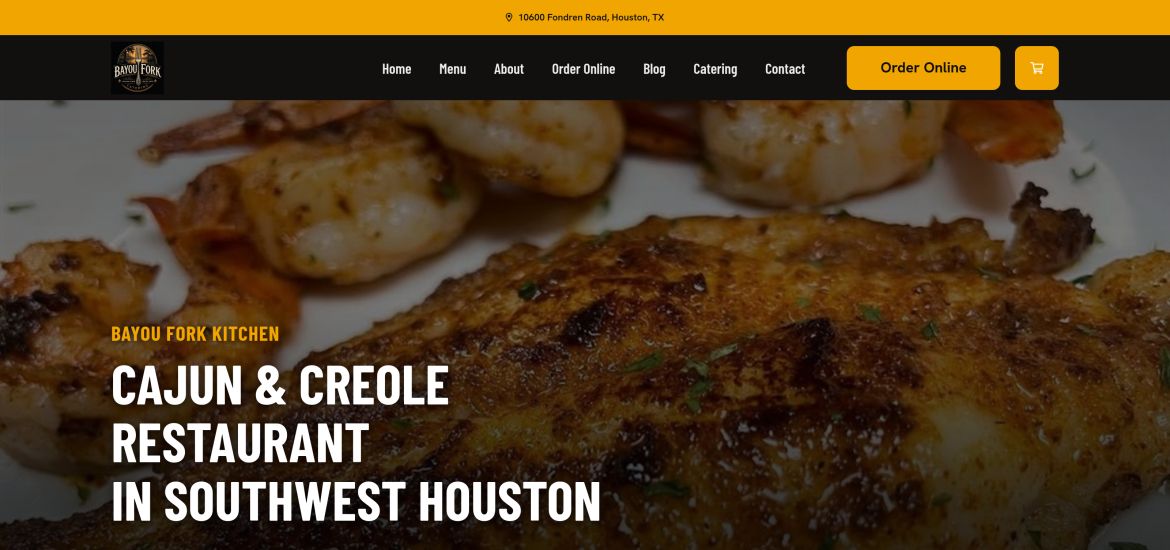
A restaurant launch works better when the website, Google Business Profile, local listings, reviews, catering path, and measurement are treated as one system. Build that system before opening day, keep every business detail consistent, and give diners one obvious next step. That is the approach we used for Bayou Fork Kitchen, where the first six weeks included measurable local visibility and booked catering work.
Opening a restaurant is already a race against time. Marketing often becomes a logo, a few social posts, and a website rushed online days before the doors open. The result may look busy without helping a hungry customer answer the questions that decide a visit: What is this place? Is it open? Is the menu right for me? How do I order, get directions, or ask about catering?
The stronger plan is to build the full local discovery path before launch. Our work for Bayou Fork Kitchen, a Cajun and Creole restaurant in Southwest Houston, is a useful real-world example.
1. Make the website useful before making it fancy
A restaurant website has three jobs: explain the concept, answer practical questions, and move the visitor toward a visit, order, or inquiry. Design matters, but clarity comes first—especially on a phone.
- Lead with the food and concept. Show what makes the restaurant distinct and use real photography as soon as it is available.
- Keep the essentials one tap away. Menu, hours, address, directions, phone, ordering, and catering should never be buried.
- Build separate intent pages. A diner looking for dinner and an office manager planning lunch need different information. Give menu, catering, private-event, and location topics dedicated pages.
- Design for mobile speed. Compress images, avoid heavy pop-ups, and test every button and form on a phone.
- Use one source of truth. Update the site whenever hours, service options, menus, or ordering links change.
For Bayou Fork Kitchen, the site needed to communicate Cajun, Creole, and Southern comfort food while making dine-in, pickup, delivery, and catering easy to understand. The result was not just a digital brochure; it was the destination behind search and map listings.
2. Treat Google Business Profile as a second homepage
Many customers will see a restaurant's Google Business Profile before its website. They may choose between directions, a phone call, the menu, photos, or another restaurant without leaving Google. A launch-ready profile should therefore be complete—not merely verified.
- Choose the most accurate primary and secondary categories.
- Confirm the address, map pin, phone, opening date, regular hours, and special hours.
- Add menu, ordering, reservation, and website links to the correct destinations.
- Upload exterior, interior, team, menu, and signature-dish photos—not only logos or graphics.
- Write a clear business description and add relevant attributes, services, and Q&A answers.
- Use tracking parameters on website links so profile traffic can be measured accurately.
Profile work continues after opening. Photos, hours, menu links, questions, and reviews all need attention. Our local SEO service connects that maintenance to the restaurant website instead of managing each channel in isolation.
3. Build accurate local citations—not a pile of random backlinks
A local citation is a mention of the restaurant's name, address, phone number, and often its website. Reputable listings can reinforce consistent business information and send referral traffic. Relevant local links—from community organizations, event partners, news coverage, suppliers, or business associations—can add stronger context.
Start with platforms customers actually use: Google, Apple Maps, Bing Places, Yelp, relevant restaurant or travel platforms, delivery partners, and credible local business organizations. Use the same official name, address formatting, phone number, website URL, and categories everywhere.
What not to do: buy hundreds of directory submissions or cheap backlinks simply to increase a link count. Low-quality placements do not fix weak pages or inconsistent business information. Prioritize accuracy, relevance, and real local relationships over volume.
4. Create a review system from the first week
Reviews help a customer judge food, service, atmosphere, and reliability. They also reveal the language customers naturally use to describe the restaurant. That makes them useful for trust, profile activity, and future website copy.
- Give staff a short, natural review request for satisfied guests.
- Use a direct Google review link on receipts, follow-up messages, or table cards where appropriate.
- Never offer a reward only for a positive review or filter unhappy customers away from the review platform.
- Reply professionally and specifically to both positive and negative feedback.
- Bring the strongest specific proof back to the website—with permission where needed.
Bayou Fork Kitchen reached a 5.0 Google rating across 56 reviews by the reporting date. That is unusually strong early proof for a restaurant that had opened on September 11.
5. Give catering its own conversion path
Catering should not be one line in the footer. It is a separate buying decision with different questions, higher order values, and a longer lead time. Build a dedicated page that explains:
- event types served, such as office lunches, family gatherings, weddings, and private parties;
- service area, fulfillment options, and advance notice;
- menu formats, dietary considerations, minimums, or the factors that affect a quote;
- proof from past events, food photos, and relevant reviews;
- a short quote form asking for date, guest count, location, event type, contact details, and notes.
The form submission is only the beginning. Track the source, response, qualification status, quote, and final booking so marketing is measured against revenue—not just clicks.
6. Write for Google searches and AI answers
Search engines and AI assistants need clear, consistent facts. A restaurant becomes easier to understand when its pages state what it serves, where it is, which areas it caters, what ordering options exist, and how a customer can take the next step.
Useful restaurant content can include catering FAQs, menu explanations, event-planning guidance, neighborhood pages, parking and access information, signature-dish stories, and clearly labeled business facts. Internal links should connect those answers to the menu, catering form, location page, and ordering options. Structured data can reinforce the page type, but it cannot replace accurate visible content.
This is the overlap between content marketing, SEO, and answer engine optimization. Bayou Fork Kitchen's early bookings also show why discovery reporting now needs to include AI: Google Search and ChatGPT were both confirmed sources across the three booked catering events, although the available records do not support a reliable per-channel split.
Bayou Fork Kitchen's early launch results
Bayou Fork Kitchen opened September 11, 2026. From opening day through October 21, three catering inquiries became booked events. The restaurant's early visibility and customer activity included:
booked catering events, Sep. 11–Oct. 21
Google Business Profile views, Sep.–Oct.
Business Profile interactions, including 88 direction requests
Google rating across 56 reviews
Google Search Console separately recorded 3,207 organic impressions and 76 clicks from September 11 through October 19. These figures show early visibility and action; they do not prove that one tactic caused every booking. The useful lesson is that the launch system gave customers multiple credible paths to discover, evaluate, and contact the restaurant.
A practical 30-day restaurant launch checklist
- Days 1–7: confirm the brand, concept, official business details, services, launch date, ordering stack, target neighborhoods, and catering offer.
- Days 8–14: build the website's core pages, mobile calls to action, catering form, analytics, and lead-source fields.
- Days 15–21: complete Google Business Profile, Apple Maps, Bing, Yelp, and relevant local or restaurant listings with identical details.
- Days 22–30: test every link and form, upload real photos, publish opening information, train staff on review requests, and verify conversion tracking.
- After opening: keep hours and menus current, reply to reviews, add event proof, review search queries, and reconcile inquiries with actual bookings each month.
Opening a restaurant—or fixing a launch that feels invisible?
We build the website, local visibility, Google Business Profile, content, and conversion path as one practical system. Start with a free review of what is ready and what is missing.
Request a Free AuditRestaurant Launch Marketing FAQs
When should a new restaurant start marketing?
Start four to eight weeks before opening. That gives the website, Google Business Profile, menus, photos, local listings, analytics, and review process time to be ready before customers begin searching.
What should a restaurant website include before opening?
At minimum: concept and location, menu, hours, directions, phone number, ordering links, catering information, an inquiry form, real photos, and clear mobile calls to action.
Do directory listings and backlinks help restaurant local SEO?
Accurate listings on reputable platforms support consistent business information and can create referral visibility. Relevant local links can also help. Bulk or low-quality link packages are not a substitute for accurate profiles, strong pages, reviews, and real local relationships.
How can a restaurant get catering leads from its website?
Create a dedicated catering page that explains event types, service area, menu options, minimums or starting information, and the next step. Use a short quote form and track submissions through to booked events.
Can restaurants be found through ChatGPT and other AI tools?
Yes. Clear business information, descriptive service pages, FAQs, structured data, strong reviews, and consistent third-party references make a restaurant easier for search engines and AI systems to understand and cite.
 Rank Forge Marketing